Monday, July 1, 2013

Looking For Brookies

A few days ago, I decided to go fish a stream that I hadn't been to in a couple of years. This particular stream is managed under the NC Wildlife Resources Commission's Catch and Release Artificial Lures Only regulations, and as of the last time I fished it contained almost exclusively wild brook trout. Although it had been a while since I had fished this creek, I had fished the stream that this creek is a tributary of several times since I was last here. The main stream is mainly a wild rainbow trout fishery, with an occasional wild brown trout. This tributary had always been a brook trout stream, and I was in the mood to go try to find some of North Carolina's only native trout species.
NCWRC Regulations Sign

Brook Trout From the Last Trip Here
The last time I fished this stream, I didn't catch very many trout, but I did manage to catch my largest (and most colorful) wild brook trout to date. I had high hopes of trying to repeat that performance, but to be honest my biggest reason for fishing for brook trout is the sheer beauty of these fish and the places they live. I knew that this particular stream wouldn't disappoint in that regard, and fish or no fish, I was looking forward to exploring some pretty country.

The Start of the Journey
The journey began where the Forest Service road ended, and it was a short hike up the old roadbed to a little one lane bridge where I knew there was access down to the stream. The road up the mountain parallels the creek, although at times it is fairly high on the ridge above it. This road has been closed off for as long as I have been coming up here to fish, but the old roadbed serves as a handy trail to hike back to the truck after a day's fishing. I appreciated this open road hiking even more after a day spend climbing boulders and bushwhacking through rhododendron thickets in search of trout. I don't know if Forest Service personnel use the road, but it does seem fairly well maintained. I've never been all the way to the end or fished this stream up into the headwaters, but I would like to hike and fish my way further up the mountain one day just to see what's there.

First Trout of the Day
Once I reached the old bridge and entered the stream, it was like I was in an entirely different world. There was no cell phone signal, no noise from the highway, no TVs or radios. All I could hear was the sound of the stream and the noises of the mountains. I worked upstream, fishing a Thunderhead dry fly, and missed a few trout before I hooked up with the first one of the day. Imagine my surprise when a wild rainbow trout came to hand, instead of the brook trout I was expecting. This was a little bit of a shock, because there is a fish barrier well downstream from where I was fishing that was put in place to help preserve the brook trout population in this stream. I don't know if the rain and high water we have had this past winter and spring allowed the rainbows to migrate upstream, or if someone thought it would be a good idea to do some stocking of their own. This had me a little concerned, because I began to wonder if the rainbows had replaced the brook trout in the years since I had last visited this stream.

One of the many plunge pools on this creek
After catching that first rainbow, I decided to continue on upstream to see what other surprises this little creek might hold. It has some excellent looking trout habitat, with plunge pools that were surprising in their depth on a creek this size. It took some careful wading, and many times climbing out on the bank, to navigate my way upstream without getting in too deep. It was a little disappointing to fish so many good looking pools without seeing a fish, but I was fishing a dry fly the majority of the time. I wondered briefly if a dry and dropper or nymph pattern would have served me better in these deeper holes, but I decided to stick with the dry fly.
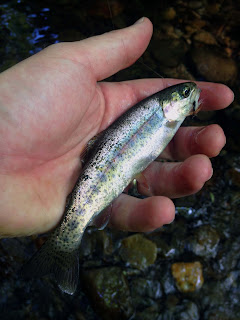
Wild Rainbow


After fishing several pools without a strike, and spooking one or two trout along the way, I hooked up with another wild rainbow trout in a large pool. This trout ate a Rio Grande Trude, another one of my favorite summer dry fly patterns for these small creeks. I had made the switch to this fly after donating the Thunderhead to the rhododendron. At this point, I was starting to wonder if my search for brook trout was becoming like looking for the pot of gold at the end of the rainbow. I was having a great time, and enjoying the challenge of fishing this small stream, but in the back of my mind I kept wondering what had happened to the brook trout that I remembered catching here. Had the rainbows displaced or out competed them? Were there any left in the creek at all? I knew the only way to answer these questions was to keep fishing.

Wild Brook Trout
Finally, after donating the Rio Grande to the rhododendron and switching back to another Thunderhead, I hooked what I had been searching for in the last pool of the day. It was a young brook trout, but I took it as a good sign for the future of these fish in this particular stream. I figured that where there are small trout, there must be bigger ones somewhere. I do think that at least a couple of the trout I missed were brook trout, because I thought I caught a flash of orange belly when the trout took a swipe at my fly. I can't say for certain that's what they were, but I'd like to think that there is still a thriving population in this creek.


One of the many millipedes
The hike back out was a lot easier than the trip upstream had been, once I found a place to climb back up onto the old road. I did see signs of some insect life along the creek, with a few Yellow Sallies and small mayflies flying around. I didn't see any rising fish, so I'm thinking that these must have been the remnants of an earlier hatch or the hatch was very sparse. Another thing that surprised me was the number of millipedes that I saw hiking into and out of the creek. There seemed to be a thriving population of them in the area along the creek.

I do know that this little creek holds some bigger secrets than the ones I was lucky enough to discover on this trip, due to some hints that the creek gave up from missed strikes. Now whether these secrets are brooks, browns, or rainbows, I'm not going to try to guess. I do know that I will be back to do some more exploring on this creek, and to enjoy the solitude that comes with small streams and wild fish. This little creek is a challenge, but one that is a lot of fun to try to figure out.

Thanks for stopping by!

- Joseph

Friday, June 28, 2013

Reflections on a Year of Ramblings

Today marks the one year anniversary of NC Outdoor Ramblings. To be completely honest, I'm amazed that it has been a year already since I started this blog. This first year has definitely been a learning experience for me about the world of blogging, and I wanted to take just a few minutes to reflect on the previous year.

To start with, I began the blog June 28, 2012 on a whim after having a conversation with my wife. I had been reading several outdoor blogs, and really enjoyed them and the unique perspective that each one brought to my favorite subjects - hunting and fishing. I was talking to my wife and mentioned to her that I thought being an outdoor writer would be an interesting career, never mentioning to her the fact that I had been playing with the idea of starting a blog. I always knew that a career in writing probably wasn't in the cards for me, and I never had any aspirations of making money off of my writing. I just enjoy being able to tell a story about the outdoors. My wife actually was the one who suggested that I start a blog, and that's when I admitted to her that I had been playing around with the idea for a while. Her suggestion was the final push I needed, and NC Outdoor Ramblings was off and running.

Initially, I struggled with the theme for this blog. It seems like the majority of the blogs that I read on a regular basis are fly fishing blogs, and for a while I thought about making my blog only fly fishing related. A few things kept me from doing a strictly fly fishing blog. One of the first reasons was that I knew in the winter time, I would struggle to find things to write about as I was likely to be out hunting instead of fishing. I figured that I didn't fish enough or tie enough flies through the winter months to have enough fresh content for the blog. Another reason I decided to stay away from a strictly fly fishing blog is I wanted to have the opportunity to write about my experiences with everything outdoors, not just fly fishing. I figured that if I made the blog name relate to fly fishing, people might be surprised to find lots of hunting stories or posts about the garden on here.

Finally, I decided to make this a blog about the outdoors in general, and I figured that would include fly fishing, hunting, and gardening - three of my favorite outdoor activities. This way, posts about an occasional hiking trip or neat pictures from the backyard or garden would have a home on the blog. Looking back over the posts from the past year, I can see a definite theme to them based on the seasons. In the spring through late summer, the posts were mainly about the garden and fishing trips, and along about September the focus switched to hunting until around the end of February. This pretty well sums up the way a typical year in the outdoors goes for me, although there are always the exceptions of late fall/winter gardening or fishing trips.

Starting off, I had no idea if anyone would ever be reading this blog, or if it would wind up being just an online journal of my (attempts at) writing. Over the past year, I feel fortunate to have made some connections with other bloggers in the outdoor blogging community, both through the Outdoor Blogger Network and through comments left here on the blog. The online world continues to amaze me, because I never would have thought about "meeting" other outdoors people in this way a few years ago. I've discovered some great blogs by writers who put me to shame, and I've hopefully been able to improve my own writing just a little in the process.

As I start my second year of writing this blog, I am looking forward to continuing to share my outdoor experiences. Thank you to everyone who has stopped by here to read, leave a comment, followed the blog or added this blog to a blog roll, liked the Facebook page, or followed me on Twitter. Hopefully this time next year, I will have lots of new experiences to reflect back on.

Thanks for stopping by!

- Joseph

Wednesday, June 26, 2013

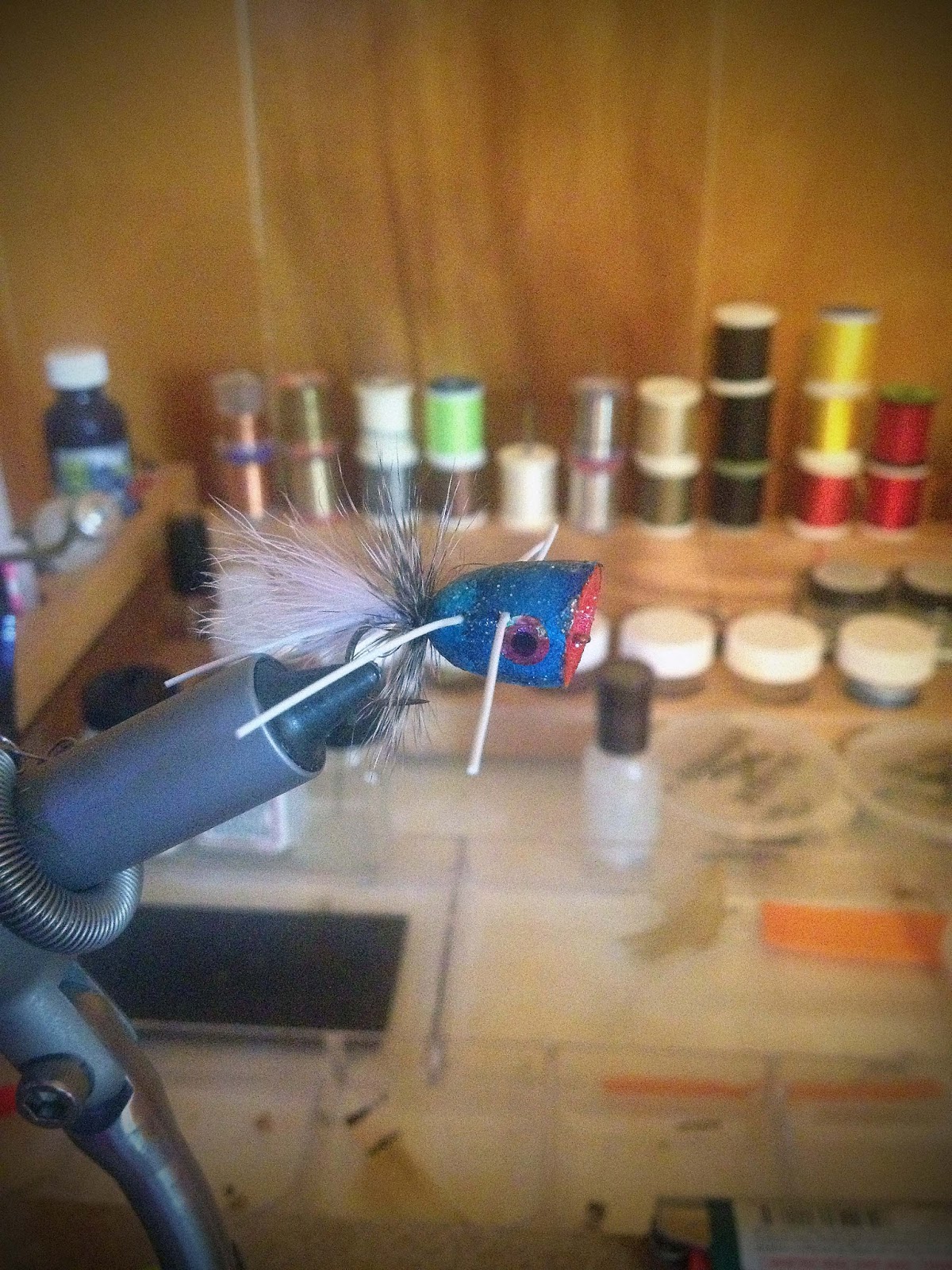
Adventures in Popper Making

The other day, while my wife and I were rambling around the Smokies, we made a stop in Townsend, Tennessee at the local fly shop where I intended to pick up some more material to tie streamers with. Of course, being a fly shop, I had to look around a little bit at all the different tying materials. I can honestly say I'm not much of a shopper at all, but put me in an outdoor store or a fly shop and it might take me a while to get out. In the course of looking around, I ran across a display of popper tying supplies. Tying my own bass and bream poppers is something that I have been meaning to learn how to do, and I figured there was no time like the present. Before it was all said and done, I had picked up enough material to tie several different colors of poppers.
My 2nd Attempt - After the Pink Popper Incident

Once we got home from Tennessee, I was anxious to give popper making a try. Up until this point, I had been buying all the poppers I fished with, and just about the only flies that I had ever tied to use in warm water had been the Triple Threat streamers that I used for smallmouth fishing. After doing a little Internet research and looking at the directions that came with the popper bodies I bought, I set out to give popper making a shot.
Yellow Popper

Right away, I was treated to some new experiences, such as the fingernail polish aisle in Wal-Mart. I had read on the Internet that clear fingernail polish with glitter worked well as a sealer for the finished poppers, and that Sharpie markers were handy to use to color the bodies. Armed with that knowledge, it was off to gather materials. I took my wife along with me for two reasons - number one, I wasn't sure I could even find the aisle with the fingernail polish, and two I figured that if she was with me it wouldn't raise as many eyebrows. She thought the whole thing was hilarious, and kept threatening to tell everyone that I was in Wal-Mart shopping for nail polish. Once that ordeal was over, it was off to the vise to give tying poppers a try.
Green Bug

The next thing I learned very quickly about tying poppers is that it takes Zap-A-Gap about .000002 seconds to bond my fingers to the foam popper bodies. After a few sticky situations, I started to get the hang of gluing the bodies on and keeping my fingers off. I also managed to eventually get my fingers all unstuck from each other and functioning again, but it was touch-and-go for a while.
Blue and White Popper

One last thing I figured out on my first attempt was that if I didn't give the marker enough time to dry, my white popper with a red face would turn into a pink popper with a red face with the first application of nail polish. I know that I've got long way to go with the learning curve on popper making, but it's fun taking on a new challenge. Now if I can just get my fingers unglued from this keyboard!

Thanks for stopping by!

- Joseph

Tuesday, June 25, 2013

Smoky Mountian Rambles

This past weekend my wife and I took a trip up to Gatlinburg, Tennessee to celebrate our third wedding anniversary. We decided to split our time between doing some of the many tourist attractions in Gatlinburg and Pigeon Forge, and exploring the Great Smoky Mountains National Park. For the purposes of this blog, I'll focus on the park itself and our rambles through it. I decided on this trip to leave the fly rods at home and just spend some time sightseeing in the park and exploring new areas that we had never visited.

Bear Warning!
As we were planning our route up, we decided to go up through Cherokee, NC and make  a stop at Clingman's Dome, the highest peak in the Smokies and third highest on the east coast. Neither of us had ever been here before, so we were excited to check out the area. On our way up to the top, we noticed a sign warning of bear activity in the area. Fortunately for us, the bears weren't out and about that day. We hiked the short trail up to the top of the dome, and walked up to the observation deck that had been built there. Unfortunately for us that day, the Smokies were living up to their name and visibility was severely limited. It was still a nice break to get out and stretch our legs after riding a few hours. We headed back down the mountain and out on US 441 toward Newfound Gap, our next stop on the trip.
Observation Tower on Clingman's Dome, GSMNP
The next stop on our journey up was at Newfound Gap, the highest point on US 441 between Gatlinburg and Cherokee. Here, we learned a little more about the history of the park, including seeing the spot where President Franklin D. Roosevelt gave the speech dedicating the park. I was also surprised to learn that the park itself was purchased and given through a joint effort by Tennessee, North Carolina, and John D. Rockefeller, Jr. It was the first time that private lands had been purchased for the purpose of creating a national park, and on our trip we would learn more about the history of the Smokies and the people who once lived here. 
View from Newfound Gap, GSMNP
 Once we arrived in Gatlinburg, we decided to check out an area of the park that I had found out about from reading on the National Park's website. The Roaring Fork motor nature trail parallelled the Roaring Fork for several miles and wound through the park from Gatlinburg. 
Roaring Fork, GSMNP
On our way through the trail, we were able to stop several times and see some of the original homestead buildings left behind when the park was created. It was amazing to think about these people making a living in that rugged country. I also learned more about the history of these settlers and how difficult life was in the mountains at the turn of the last century.
Ephriam Bales Cabin, Roaring Fork GSMNP
On our way out of the park on the last leg of the motor trail, we were fortunate enough to get to see a black bear cross the road in front of us. In all my years trout fishing in bear country, I've never seen a bear in the East. In fact, the only wild black bear that I had ever seen previous to this trip was in Yellowstone Park. I was excited for my wife too, because this was the first wild bear that she had seen. After the bear crossed the road, we were lucky enough to be able to get a picture (from inside the car) as it paused on the side of the mountain. 
Black Bear, Roaring Fork GSMNP
After the Roaring Fork, the next day we decided to head toward another popular area of the park, Cades Cove. We had been through this area on previous trips, and it is one of the most popular areas of the park for wildlife viewing, which is what we had in mind. On our way out to Cades Cove, we spotted our second black bear standing on the bank of the Little River. This one unfortunately didn't give us a chance for a photograph, but it was larger than the bear we saw the day before. The drive out to Cades Cove following the Little River gave us the opportunity to view Meigs Waterfall, along with blooming rhododendron and beautiful views of the river.
Meigs Waterfall, GSMNP
 On our trip through the cove, we saw numerous wild turkeys and whitetail deer, and also saw more of the historic buildings left behind by the settlers of Cades Cove. It was amazing to see just how little the deer in this part of the park were bothered by people, but I'm sure with the amount of visitors this area sees every year the wildlife has become accustomed to posing for pictures.
Whitetail Doe, Cades Cove GSMNP
One other area of the park that we had planned to explore was the Cataloochee Valley. We had both been wanting to explore this area and see if we could see some of the elk herd that was introduced to the area by the Park Service several years ago. We saved this for last, as we planned to visit the area on the way back home. 
Cataloochee Valley
After travelling the winding gravel road over the mountains that followed the course of the old Cataloochee Turnpike that served as the main road for the settlers that lived in the valley, we arrived in the valley itself. It was interesting to learn that at the time of the park's creation, the Cataloochee Valley was the most populated area in what was to become the park. Our main purpose for the side trip into Cataloochee was to hopefully get a look at some of the elk that were introduced into the valley in 2001. As we drove through the valley, we did see an elk calf in one of the first meadows. This was the only elk that we observed on the trip through the valley, but we plan to come back again and explore the area more. 
Elk Calf, Cataloochee GSMNP
Overall, it was a great weekend for wildlife watching and exploring in the most visited National Park in the country. I did see several places that I've put on my list to explore with a fly rod one of these days, and also made a side trip to Townsend, TN to do a little shopping at a fly shop. The park provided a nice change from the traffic and bustle of Gatlinburg, and I'm sure we'll be back to visit it again soon.

Thanks for stopping by!

- Joseph


Wednesday, June 19, 2013

What Do You Think?

Edit: Evidently Facebook is not supporting the poll feature on the page right now. Sorry about that for anyone who tried to answer it. If you get the chance, feel free to check out the page and give it a "Like", but I've removed the poll question. Please leave your feedback in the comments on this post. Thanks!

I've been writing this blog for almost a year now, and since I started the template and layout here have basically remained the same. I decided today to change things up some, and wanted to get everyone's opinion on the changes. If you don't mind, please let me know what you think of the new look here at NC Outdoor Ramblings, either by answering the poll on the blog Facebook page at NC Outdoor Ramblings on Facebook or by leaving me a comment on this post. I'd really appreciate everyone's feedback on this. Is the new look easier to read? Harder to read? Too distracting? Just right? I'll give it a while and see what the general consensus is before I decide to make the new look permanent.

As always, thanks for stopping by!

- Joseph

Tuesday, June 18, 2013

Chasing Wild Rainbows

This spring and summer so far have been different than in the past few years. We seem to have had a lot more rain, and consequently our garden is doing quite well. I've been anxious to head up into the mountains to see what kind of impact the wet weather has had on the trout streams, and yesterday I finally got the opportunity to go chase some wild trout for a few hours.

I decided to fish a stream that I have fished off and on since I began trout fishing several years ago.  The past few years I've had mixed results fishing this stream, but I'm not too surprised because it is in a fairly heavily used area of the Pisgah National Forest, and the forest service road parallels the stream making for easy access. I'm sure the  trout here are fished for fairly often, although I didn't see anyone fishing yesterday. It's interesting to see how things have changed since I started fishing here, although all my evidence is anecdotal. I used to catch more of a mix of species, with rainbows and browns being fairly equal in numbers with an occasional brook trout thrown in the mix. The last few years, I've not caught any brookies in this stream and the vast majority of trout have been rainbows with only an occasional brown.
Heading Upstream
I arrived to find the stream in better shape than I had seen it in the past few summers. There was lots of water, and the flow was up due to the recent rains. I was a little worried on the drive up because I knew that there had been some thunderstorms in the area overnight, and I woke to find a flood watch in effect for the southern part of the county where this stream is located. There isn't a USGS gauge on this stream, but I checked the ones in the surrounding area and saw that there was only a minimal increase in water flow. Based on this, I decided to go ahead and take a chance, knowing that there were other streams not too far away that should be fishable if flows were too high. When I arrived, I was pleased to find the creek running clear and low enough to make for fairly easy wading. It reminded me of the way this stream used to look back before the dry summers of a few years ago. 
Wild NC Rainbow Trout 
Some of my best wild trout have come from this stream over the years, but it seems that the overall size of the trout here has decreased in the last few years. I was curious to see if the higher flows would bring out the larger trout, or if there were even any there anymore. I have a feeling that the low water of the past few years may have hurt the trout population in this creek, but that is just speculation on my part. Yesterday's catch was all rainbow trout of about 5-6", although I did miss a nice fish due to a too anxious hook set on my part. This fish was holding in a nice pool formed by the trunk of a fallen tree lying parallel with the bank. After several aggressive strikes from the smaller trout that morning, I was caught off guard when this larger fish slowly and deliberately rose to my fly, and I feel certain I tried to set the hook and pulled the fly away before it had a chance to eat it. 
Beautiful Colors
All the trout yesterday came on dry flies, with the Thunderhead and deer hair caddis each accounting for about half of the fish. There are a few large, deep pools on this creek that just seem to scream "Big fish here!", although I've only caught a trout out of one of them once. I tried stripping a small streamer through these pools yesterday, hoping to entice a big brown, but there were no takers. The pools themselves were just slightly dingy from the rains, and I was hoping that this would have the fish feeling a little more secure. Someday maybe I will figure out the secret to these holes, but until then the mystery of them keeps things interesting. 

One thing that I absolutely love about fishing for wild trout is the amazing colors that these fish have. All the small ones yesterday still had their parr marks, and the bright red stripes and dark spots made a pretty combination. All in all, it was a great day to get out and ramble around in the mountains. Now I can't wait to do it again!

Thanks for stopping by!

- Joseph

Thursday, June 13, 2013

Tater Time and Other Garden Updates

One thing I really enjoy about planting a garden each year is the opportunity to experiment a little with new crops or new varieties of crops. I do still find myself planting some of the old standbys that my grandfathers grew, but I also enjoy the chance to try new things. This year, one of my experiments was growing potatoes in our garden. I remember my grandfather growing potatoes when I was young, but we had never tried them ourselves. Since I had never grown potatoes before, I decided to experiment with a few different varieties to see which ones yielded best and also which ones (if any) we preferred over the others when it came to taste.
Planting Potatoes - March 2013

I knew from my years working at the local hardware store that most people in our area planted Kennebec potatoes, so I decided to do a full row of those. I also planted a half row of Yukon Gold and half a row of Red Pontiac potatoes to add some variety. Having never grown any potatoes before, I was a little anxious to see the results. We planted our potatoes back in mid March, and yesterday was the big day when we would finally dig the vines up and see the results.

Kennebec Potatoes
The first row we dug were the Kennebec potatoes. I was fairly impressed with both the size and yield that we got from our vines. There were several that were big enough to make some nice sized baking potatoes, and lots of smaller ones that will be good for mashed potatoes or other uses. Overall I'd say that the row yielded between 40 and 50 pounds of potatoes from 5 pounds of seed potatoes.

Yukon Gold Potatoes
Next up were the Yukon Gold potatoes. I didn't expect to get as many of these or the Red Pontiacs as we did of the Kennebec because I only planted roughly 2 1/2 pounds of seed potatoes of each of these varieties. I was pleased with the size of the Yukon Golds, but each vine only seemed to have a few potatoes on it. This could have been due to any number of factors, but overall this year the Yukon Golds were my lowest yielding potatoes. I was pleased with the size of the potatoes I did get, so this was a case of quality over quantity.
Red Pontiac Potatoes
The last of the potatoes to be dug were the Red Pontiacs. Right away I was impressed by both the size and the number of potatoes that were on each vine. I had read that this variety of potatoes does well in heavier soil, and even though we have added compost to our garden to help loosen the red clay it still makes things a little less than ideal for potato growing. Overall, I would say that the Red Pontiacs were the highest yielding of the three varieties that we planted. We got almost as many potatoes from a half row of these as we did a whole row of the Kennebecs. These potatoes also seemed to be larger on average than the other two. Overall, my wife and I were pleased with the results of our first potato crop, and we're already making plans to grow potatoes again next spring.
Total Harvest L-R Kennebec, Red Pontiac, Yukon Gold

Once all the potatoes had been dug, I tilled up the area of the garden that they occupied this morning and planted some Beauregard sweet potato slips in their place. I had tried sweet potatoes last year, but I think a combination of late planting and a little bit of neglect on my part with keeping weeds out led to us only getting  a few very small potatoes off the vines. This year I'm going to try to do a better job keeping up with them, and hopefully between that and an earlier planting we will see some better results. 
Sweet Potatoes
Potatoes aren't the only thing coming out of the garden lately. I harvested our onion crop on Tuesday, and as in the previous couple of years, the Georgia sweet onions that we plant did well. This year I did have several onions bolt and flower, something that hasn't happened to me before. I don't know if the warm then cold then warm weather we had earlier this spring was the culprit, or if it was all the rain, or if it just was something that was bound to happen. Either way, we were happy to get some fresh onions.
A few of our onions
The rest of the garden is coming along, and it shouldn't be too much longer before some of our other crops start coming in. I picked the first yellow squash of the year this morning, and also saw some nice sized green tomatoes on the vines. There were also a few small peppers on the pepper plants, and the cucumbers and cantaloupe vines were blooming. The corn is about chest high, and the watermelon vines are starting to run. It is an exciting time of year to be gardener!
Green Better Boy Tomatoes
Crookneck Squash

Thanks for stopping by!

- Joseph